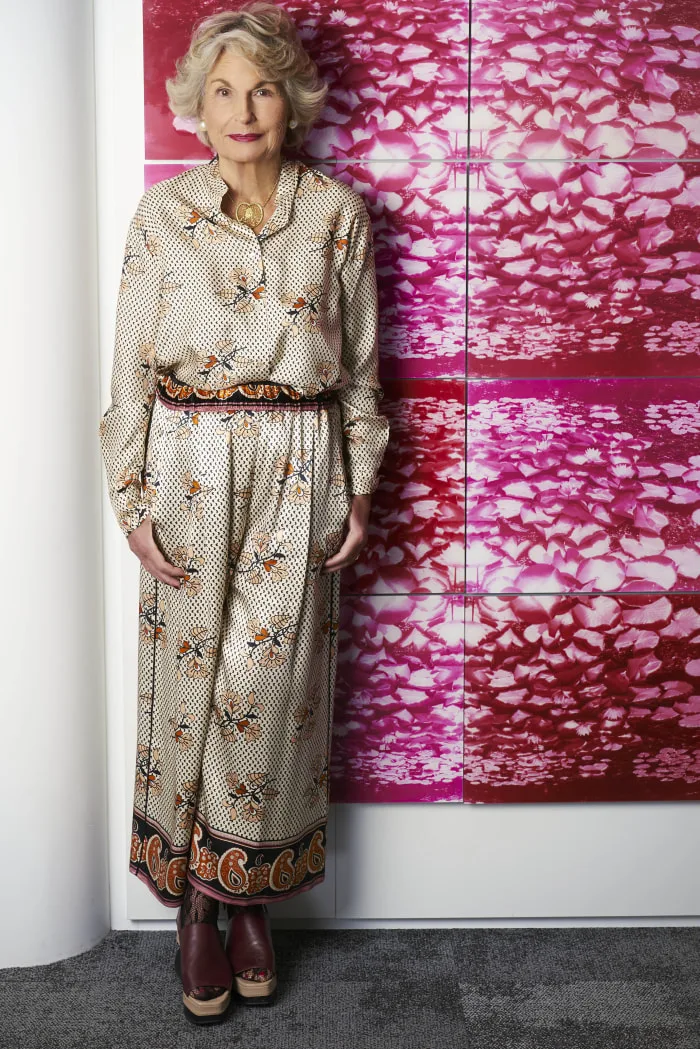
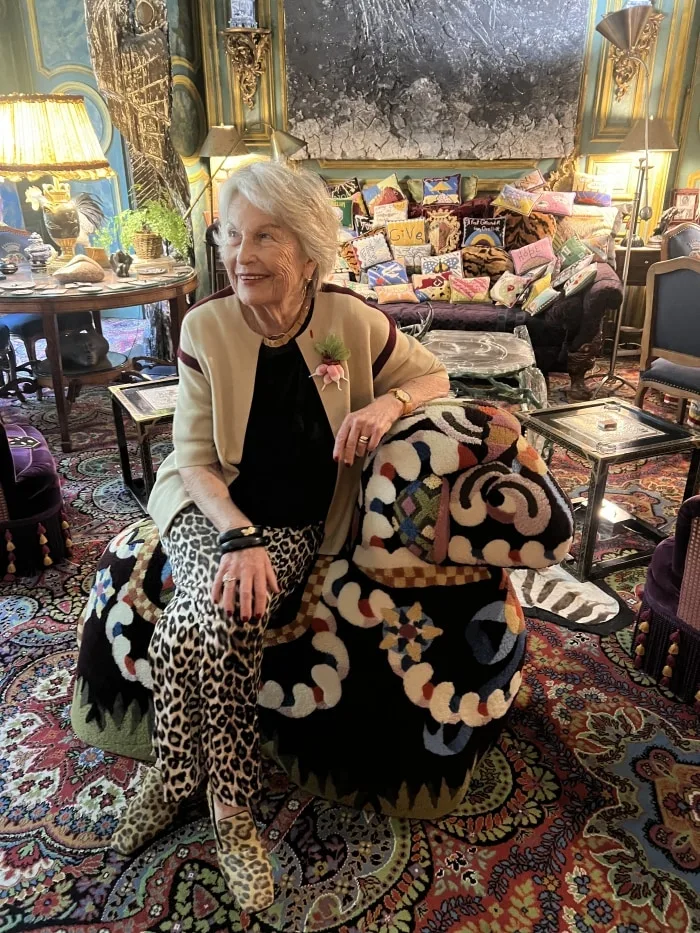
Isabelle d’Ornano at Sisley headquarters in Paris. Photograph by Oleg Covian.
“In the postwar years, one wasn’t thinking about oneself, but about what we could do, really, how we could find a place in the world,” Countess Isabelle d’Ornano says of her trajectory from living out of a suitcase in a refugee camp to co-founding a global cosmetics brand. “We were displaced people.”
Born into a Polish aristocratic Catholic family with ornate palaces and substantive political influence, d’Ornano descended from the Radziwill line of Polish princes to Prussian kings. WWII destroyed that world. Stalin nationalized the family homes, never to be returned.
After the war, d’Ornano’s family settled in Spain, where she had “a happy childhood, but with very little money.” At 15, she went to work to help pay her part of the family rent. Working came naturally, because it allowed “adventure and independence.”
After two decades working in haute couture and cosmetic companies owned by her husband, Hubert d’Ornano, the couple embarked on a joint business endeavor by founding Sisley Paris. They pioneered phytocosmetology—using plant extracts and essential oils in combination with advanced technological research. Sisley is now a globally recognized high-end skin-care, makeup and perfume brand, employing 5,000 people with 8,049 stores and outlets worldwide.
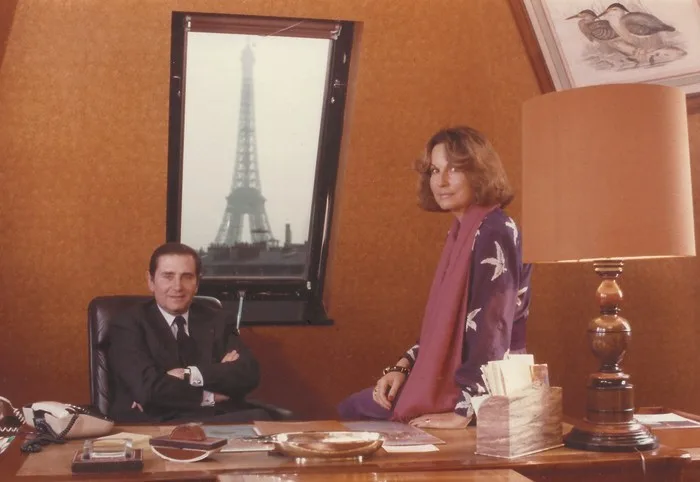
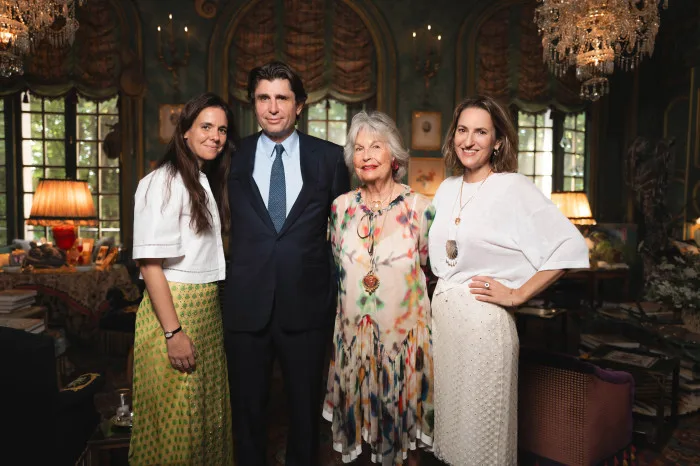
D’Ornano oversaw product research, helping to compose some of Sisley’s most iconic skin-care creams and scents. At 89, she remains Sisley’s president of the Supervisory Board, with her son and daughter in the two top roles: Philippe as president and Christine as global vice president.
Along the way, always “enjoying work more than play,” d’Ornano had a rollicking good time. “We did know everyone everywhere in Europe, and in America, and in England.” Her uncle Stanislaw Radziwill married Jackie Kennedy’s sister “Lee” Bouvier, and d’Ornano still lives by a lesson Jackie taught her shortly before her death.
As a woman who left palaces behind and dusted off the debris of war to create a family empire, d’Ornano expresses her life philosophy through art and words embroidered on pillows. “They’re like postcards,” she says. “One I finished is being mounted: ‘Not all those who wander are lost.’”
When you and your husband created Sisley in 1976, he had decades of experience in cosmetics. He co-founded Orlane. His father co-founded Lancôme. He could have hired a tested male executive. Instead, he chose you as his business partner. Why?
You’d have to ask him.
Sadly, he’s not around to ask, and I think you know the answer.
What I had and added was this ease with people, that I was direct and scared of no one. I just feel it’s not something I’ve learned. It’s something that is my nature. If they tell me, you have to conquer this thing to be conquered. I will conquer it. I’ll really try to conquer it.
You quickly became a person of authority in the companies you worked for. Did you ever use the word feminist to describe yourself?
Like many women of my generation who worked right away after the war, I don’t like the word feminist because I find it’s unnecessary. I find that women are at least as capable as men. But they are different.
Do you remember anyone questioning your authority?
You know, no one questions you at all as long as you’re not successful. But when you are successful, first financially and afterward, the wolves come in to find a problem.
Did you have to lose some of your femininity to be a leader? Did you compromise your femininity in any way?
The opposite. I find it helps. One’s femininity shouldn’t ever be diminished on purpose. People say I have a certain, unusual flair.
Define your flair.
Seeing trends before others. Even in design, it’s what is in the air. It’s what you’d feel in the street that people will want in a few years’ time, as if you know it before others feel it.
Do you have good taste?
Taste is wonderful, but it’s not everything. You can be very boring with good taste.
Can you define poor taste?
Taste is not a question of money. But poor taste is more dramatique because with poor taste you can put a lot of clothes and jewelry on yourself or fill your home with objects to display your poor taste. And poor taste in design is a pity because it’s a bore.
What role did luck play in Sisley’s success?
Luck plays no part in quality, that’s the work and determination of a team. It isn’t enough to have ideas. You must have the capacity to put these ideas into action, to actualize them. Luck plays a part just in life; you have to have luck in life sometimes.
And why doesn’t luck play a big role in business?
Because you can’t leave things to luck. That’s not enough. You must build the business solidly. I always recommend it to people who have ideas for business, to start small and let it grow by its own strength from the inside, and not just because you have made a fantastic launch, and all the magazines or media are talking about you.
What was different about Sisley that set you apart and allowed you to grow it from scratch?
Emphasis on plants, but combining nature with technology. Working with plants is more complicated, because having a sophisticated formula with plants is not easy. It’s very expensive because you have to test a lot, more than with synthetic products.
Once Sisley was five years or seven years old, and you were locked and loaded, what did you see as your comparative advantage?
Our comparative advantage was having a family business, not having any other investors in the business, and at one point getting our children interested in it. I loved my work, but it wasn’t the end all goal in my life. It wasn’t an obsession.
Why is not having outside investors an advantage?
It’s an enormous advantage not to be on the stock exchange. The people who have other investors spend more time explaining what they’re doing than working on their business.
Do you like working with Americans?
I love New York, but I’ve also spent much time in Texas, California and Chicago. There’s excitement in the air. It’s very American in spirit. And when working in New York, I’d always want to conquer certain things for the business.
Your husband was a French count, and you came from an aristocratic European family that traces back to the Kings of Prussia. Your uncle was President John F. Kennedy’s brother-in-law. Did that lineage help your business?
We knew a lot of people in every country. The best people one could know. This is a big advantage. We never worried about that. Although my family lost all their money after the war, they did know everyone everywhere in Europe, and in America and England. We never had trouble going to a place and seeing the people we needed to see.
When did you realize your company was a success?
After about 10 years in New York, we were invited by a lot of fashionable people. One night at dinner, someone said they didn’t know who d’Ornano was, but they knew Sisley. I knew we’d won.
You knew Jacqueline Kennedy Onassis. What was Jackie’s allure?
You had the impression with her that everything she did, she knew that people would remember. If she put her hand on your shoulder, you would remember it. Her history was very much imprinted on who she was. Having her husband killed on her lap is something you couldn’t help thinking about when you were with her.
You saw Jackie often at lunch at the round table in her living room.
Privately, she was a real human being. She was someone who understood the meaning of doing small things, how large the effect would be.
Give an example.
I always sent Jackie an invitation to an art show by a Radziwill cousin, the family her sister Lee married into. The first time she said she just couldn’t come, but the second time she sent me a message, about four months before she died: “If I may, I’m buying the picture on the invitation.” I thought I must get it to New York before something happens. I got someone to accompany it and I told a director at Air France that it was for Jackie. He gave a seat to the picture, next to the person bringing it, and it got to Jackie in time. She had said to me, “I missed buying that first exhibition. I don’t want to miss it this time.” I thought it was incredible, someone who knows she’s going to die buys something meaningful.
You embroider your philosophy on pillows and cushions. You even published a book about your collection. Tell me one that captures your belief about business.
“You must grow without getting fat.” This means you must nurture the DNA of the business.
And what about life?
I embroidered on another cushion the words the pope sent to King Charles the Third for his coronation. He sent a beautiful cross and behind was inscribed, “Be joyful, keep the faith, do little things.” Jackie knew about that. People think about doing great things, but to say, “do small things” to a king, c’est formidable.